Vector Tiles API
Live and lightweight Vector Tiles API service
Vector Tiles API
API as Vector Tiles Format
Vector tiles API is mainly based on the lightweight and blazing fast Martin project of Urbica. Through this Docker Image, anyone can install Martin and get data from the Postgres/PostGIS tables in vector tiles format. vector tiles are ready to serve over vector basemap as native lative layer and its behavior over the Basemap can be used like vector tile layer
For more documentation and endpoints go to the Documentation of Vector Tiles API page.

Discover all the Vector Tile APIs from PostGIS and Endpoints
Map Design Tool & Vector Tile API Endpoints
Map Design Too- {domain:port}
- Usually, the port is 8888 where the map design toom can be found
1. Vector tiles API in pbf formt- {domain:port}/public.planet_osm_line/{{z}}/{{x}}/{{y}}.pbf
- Vector tiles API Test
2. Table tilejson API- {domain:port}/public.postgis_spatial_table_name.json
- Search API Test
TEST ALL VECTOR TILES API...

Test the Vector Tiles API live
Stand-alone Vector Tiles API
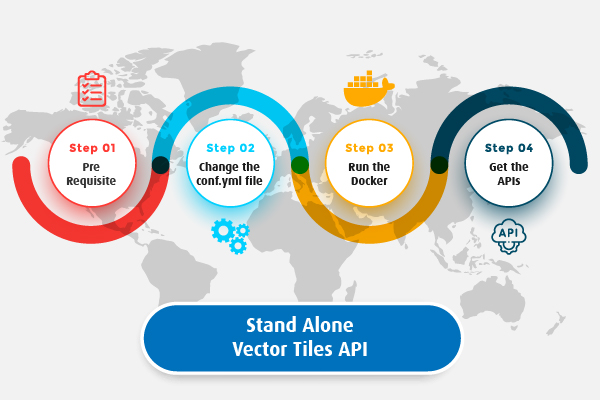
LocusQ Master stack covers all the segments of web GIS such as maps, routing, direction, transit, geocoding and many more tools. Besides this, Vector Tiles API can be installed as a stand-alone service if anyone does not need few other services or only 2-3 services. Here are the steps
-
Pre-requisite
Map Engine can not be run alone as it needs map data processing. this is why
locusq-postgisis needed in the backend. go to Locusq PostGIS page to see how to install it. -
Change the
conf.ymlfileChange the configuration file according to your needs. Country-wise configuration code can be found here.
-
Run the standalone Vector Tiles API Docker
Pull or run directly the Vector Tiles API docker image keeping the
conf.ymlfile in the same directory from where the docker is runningdocker run -it --name vector-tiles-api --network locusq -v $(pwd):/data -p 4707:3000 locusq/vector-tiles-api:latest -
Get the APIs
Wait a few minutes and check the status of service readiness with the following command
docker exec -it vector-tiles-api status
When the service is ready, connect the PostGIS server.